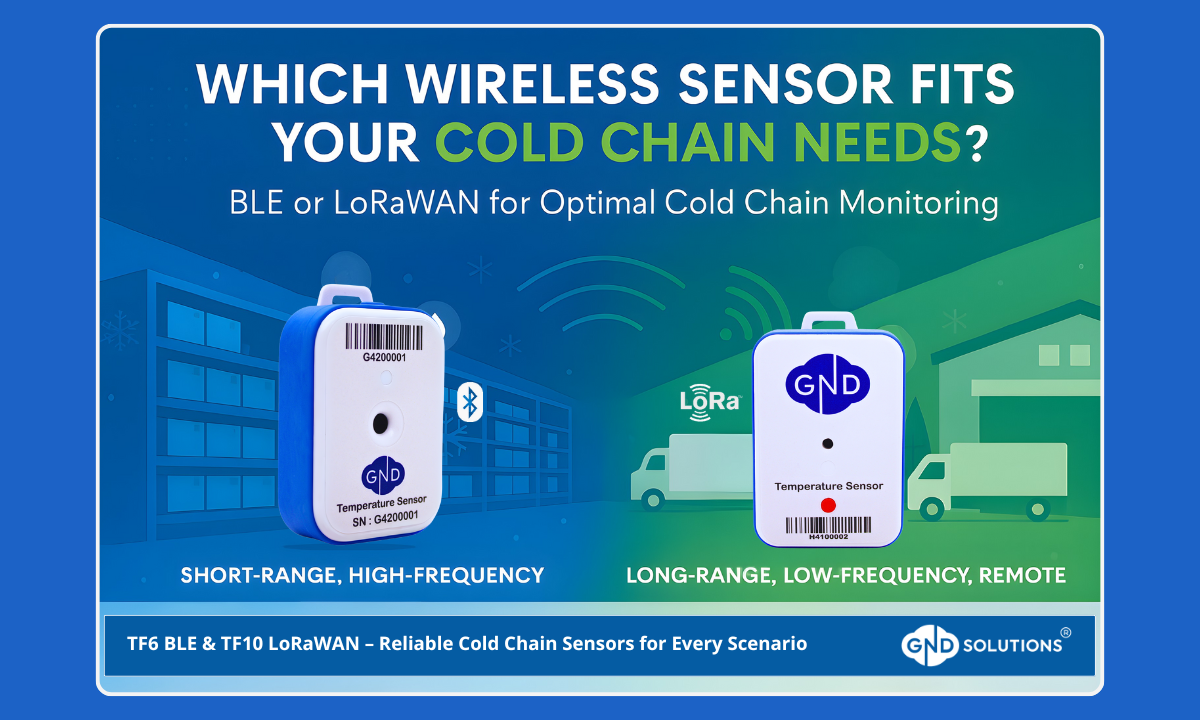
Which Wireless Sensor Fits Your Cold Chain Needs: BLE or LoRaWAN?
Digital TransformationJuly 7, 2025 • 6 min read
TL;DR
Choosing the right wireless sensor technology for cold chain monitoring depends on your environment, range needs, and data frequency.
BLE sensors like GND's TF8 excel in indoor, short-range, high-data environments, while LoRaWAN sensors like TF10 offer long-range connectivity for wide-area or remote applications.
Both deliver reliable temperature and humidity monitoring with secure communication and long battery life.
Understanding Wireless Sensor Technology for Cold Chain Monitoring
Maintaining the integrity of temperature-sensitive products requires dependable and precise monitoring tools. Wireless sensors have transformed cold chain management by enabling real-time data access that enhances asset safety, efficiency, and regulatory compliance.
Among the available wireless technologies, Bluetooth Low Energy (BLE) and LoRaWAN stand out as two leading options, each with unique advantages.
BLE sensors, such as GND Solutions' TF8 series, are ideal for dense indoor sensor networks that need rapid data transmission and seamless integration within Bluetooth ecosystems.
LoRaWAN sensors, such as GND Solutions' TF10 series, are suited for longer-range monitoring across distributed facilities, outdoor environments, and remote cold chain operations.
This article compares BLE and LoRaWAN protocols, explains how the TF8 and TF10 perform, and helps you decide which fits your cold chain operations best.
BLE vs LoRaWAN: Technical Comparison
Choosing between BLE and LoRaWAN depends on your monitoring environment, range requirements, and data frequency needs.
Connectivity and Range
BLE offers efficient, short-range wireless communication for indoor setups such as warehouses and pharmaceutical cold rooms, supporting up to 460 meters line of sight.
LoRaWAN provides long-range connectivity up to 3,000 meters line of sight for distributed facilities, outdoor monitoring, and supply chain tracking.
Power and Battery Performance
Both GND Solutions TF8 (BLE) and TF10 (LoRaWAN) sensors offer approximately 3 years of battery life under standard 10-minute reporting intervals.
BLE performs best with frequent communication and short transmission paths.
LoRaWAN is optimized for low data frequency and remote or hard-to-reach environments.
Environmental Tolerance and Security
Both sensors operate from -30°C to +70°C and can extend monitoring from -200°C to +350°C using external probes.
TF8 BLE sensor: IP65-rated enclosure for controlled indoor or semi-protected environments.
TF10 LoRaWAN sensor: rugged IP67 rating for dust, humidity, and outdoor elements.
Security: 256-bit key exchange and AES-128 encryption for both sensors.
TF8 vs TF10 Sensor Specifications
Feature
TF8 BLE Sensor
TF10 LoRaWAN Sensor
Connectivity Technology
BLE 5.0 / 5.4
LoRaWAN
Communication Range (LOS)
Up to 460 meters
Up to 3,000 meters
Battery Life
3 years (10-min reporting)
3 years (10-min reporting)
Operating Temp Range
-30°C to +70°C
-30°C to +70°C
External Probe Temp Range
-200°C to +350°C
-200°C to +350°C
Humidity Range
0% to 100% RH
0% to 100% RH
Enclosure Rating
IP65
IP67
Data Storage
Up to 11,000 records
Up to 2,000 records
Security
256-bit key exchange, AES-128
256-bit key exchange, AES-128
Dimensions
62 × 42 × 19 mm
80 × 65 × 25 mm
Key Benefits of GND Solutions Wireless Sensors
TF8 BLE Sensor Advantages
Compact and cost-effective for indoor, dense network setups.
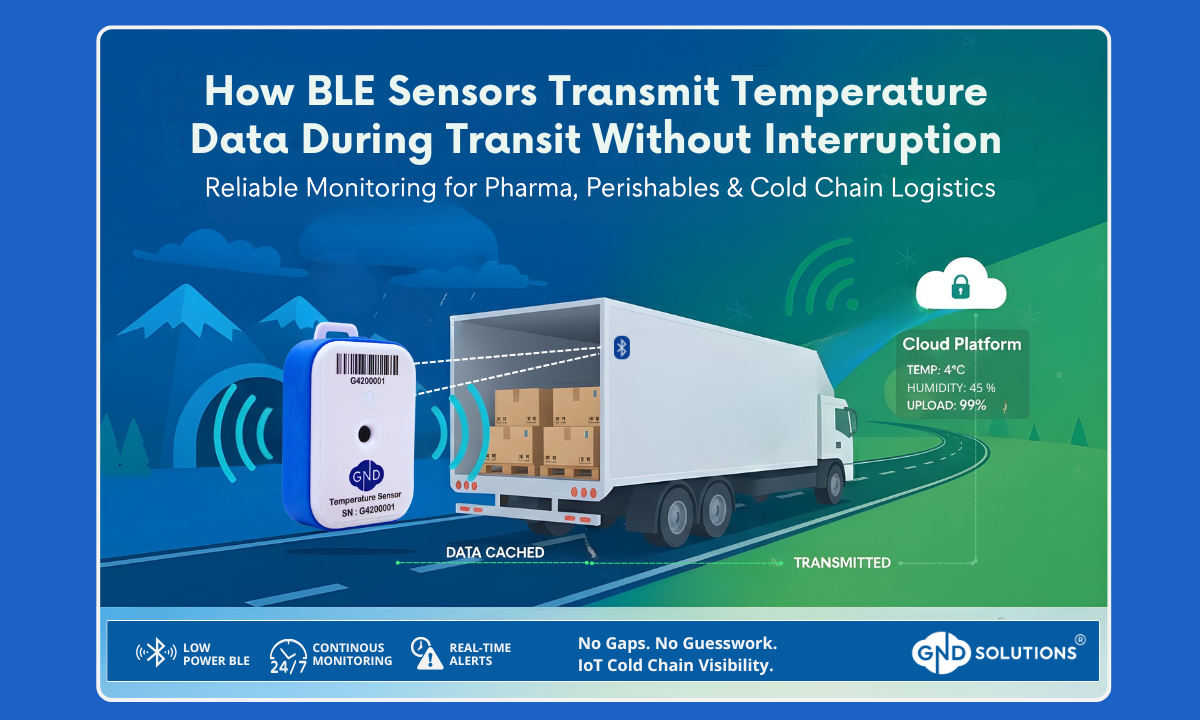
High onboard data storage up to 11,000 records minimizes data loss during connection gaps.
Ideal for logistics hubs, cold storage rooms, and pharmaceutical environments requiring short-range, high-precision sensing.
TF10 LoRaWAN Sensor Advantages
Long-range connectivity suitable for distributed warehouses or outdoor cold chain applications.
Rugged IP67 enclosure withstands dust, moisture, and temperature fluctuations.
Ideal for large-scale or remote deployments where maintenance access is limited.
Use Cases for BLE and LoRaWAN Sensors
BLE Sensor (TF8)
Indoor cold storage and refrigerated rooms
Pharmaceutical warehouse temperature control
Facility asset tracking and localized hospital or lab environmental monitoring
Retail refrigerator temperature management
LoRaWAN Sensor (TF10)
Remote cold chain logistics and transport monitoring
Outdoor agriculture and environmental sensing
Multi-site warehouse monitoring
Smart city storage and utility applications
Wide-area supply chain asset tracking
FAQs: Choosing Between BLE and LoRaWAN for Cold Chain Monitoring
How do I choose between BLE and LoRaWAN for my cold chain?
Consider range, infrastructure, and data frequency. Choose BLE for short-range, high-frequency indoor environments. Opt for LoRaWAN for wide-area or outdoor applications with less frequent updates.
Are these sensors secure?
Yes. Both feature AES-128 encryption and 256-bit key exchange for reliable end-to-end data protection.
What is the battery life of TF8 and TF10?
Both offer up to 3 years of battery life at a 10-minute sampling interval.
Can I use external probes with these sensors?
Yes. Both models support external probes for extended temperature monitoring from -200°C to +350°C.
How do these sensors integrate with monitoring platforms?
They connect seamlessly to GND Solutions' ThinxView platform or custom IoT dashboards for real-time monitoring, reporting, and alert notifications.
Conclusion: Selecting the Right Wireless Sensor for Your Cold Chain
Both BLE and LoRaWAN technologies are reliable options for cold chain monitoring. GND Solutions' TF8 BLE sensors deliver fast, precise data for compact indoor environments, while TF10 LoRaWAN sensors enable long-range communication across distributed or outdoor facilities.
Selecting the right model depends on your operational scope, infrastructure, and reporting requirements. By aligning your deployment needs with each sensor's strengths, you ensure accurate monitoring, product safety, and regulatory compliance across your cold chain.
Explore GND Solutions' full sensor portfolio or contact our IoT experts to identify the best solution for your cold chain operations.
Found this useful? Share it with your network
Request a Demo
Get a personalized walkthrough of GND's Cold Chain platform and see how our sensors, dashboards, and alerts can fit your operations.